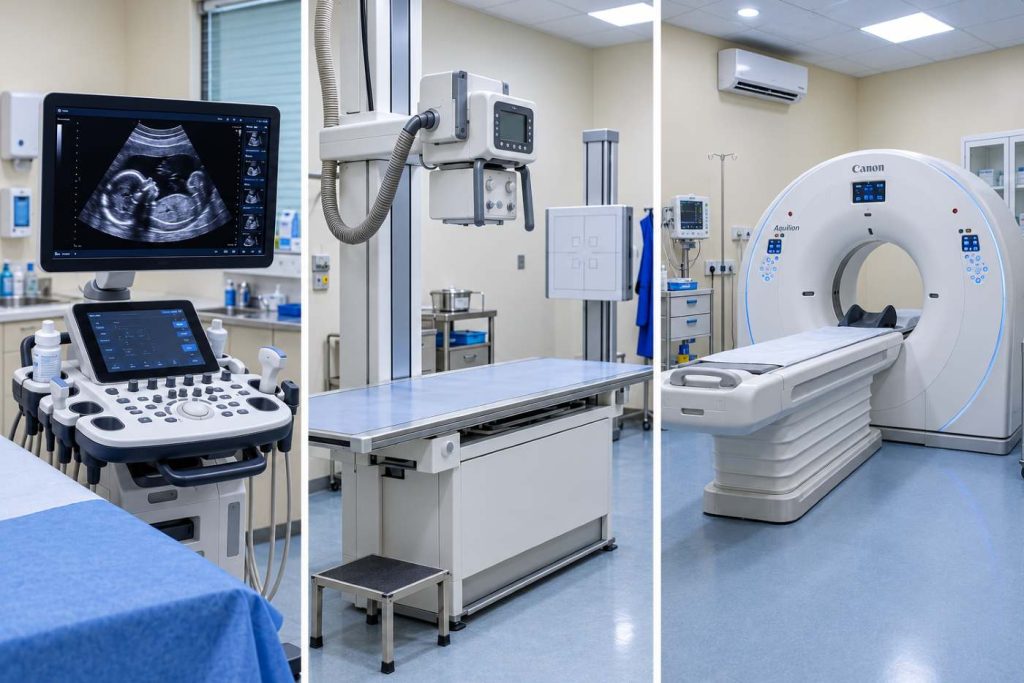
Patients are often told they need a scan without being told why that particular scan was chosen.
Different imaging methods answer different questions, and the choice depends on what a clinician needs to assess.
X-ray
X-ray is often the first imaging test used for bones and the chest.
It is quick, widely available and effective for many common questions, including suspected fractures and respiratory symptoms.
Rapid Diagnostics provides high-frequency digital X-ray.
Ultrasound
Ultrasound uses sound waves rather than radiation.
It is widely used in pregnancy and for examining soft tissue and abdominal organs, and it shows structures moving in real time.
Advanced techniques such as elastography can add information about tissue stiffness.
CT
CT builds cross-sectional images from a rapid series of X-ray images.
It provides considerably more anatomical detail than a plain film and is used for complex questions, including vascular studies and detailed organ assessment.
Rapid Diagnostics provides CT including angiography, triphasic liver studies and urography.
MRI
MRI uses a strong magnetic field and radio waves rather than X-rays.
It is particularly valuable for soft tissue, including the brain, spine, joints and many internal organs.
Scans take longer than CT, and safety screening is required because the magnetic field is always on.
Fluoroscopy
Fluoroscopy produces a continuous moving X-ray image.
It allows structures to be observed as they function and can guide instruments during a procedure.
Mammography
Mammography is a low-dose X-ray examination of the breast, used for screening and for assessing a specific concern.
It may be combined with ultrasound where further characterisation is helpful.
Which one do you need?
That is a clinical decision.
Your doctor considers your symptoms, history, examination findings and the question that needs answering before requesting a particular study.
More detail is not automatically better. The right test is the one that answers the question with appropriate safety and preparation.
Radiation and safety
X-ray, CT, fluoroscopy and mammography use ionising radiation, while ultrasound and MRI do not.
Where radiation is used, protocols are selected to answer the clinical question with an appropriate dose. Tell the team if you may be pregnant.
Rapid Diagnostics guidance: Which imaging test is appropriate for you is a clinical decision made by the doctor who knows your history.
Explore our full range of radiology and imaging services.