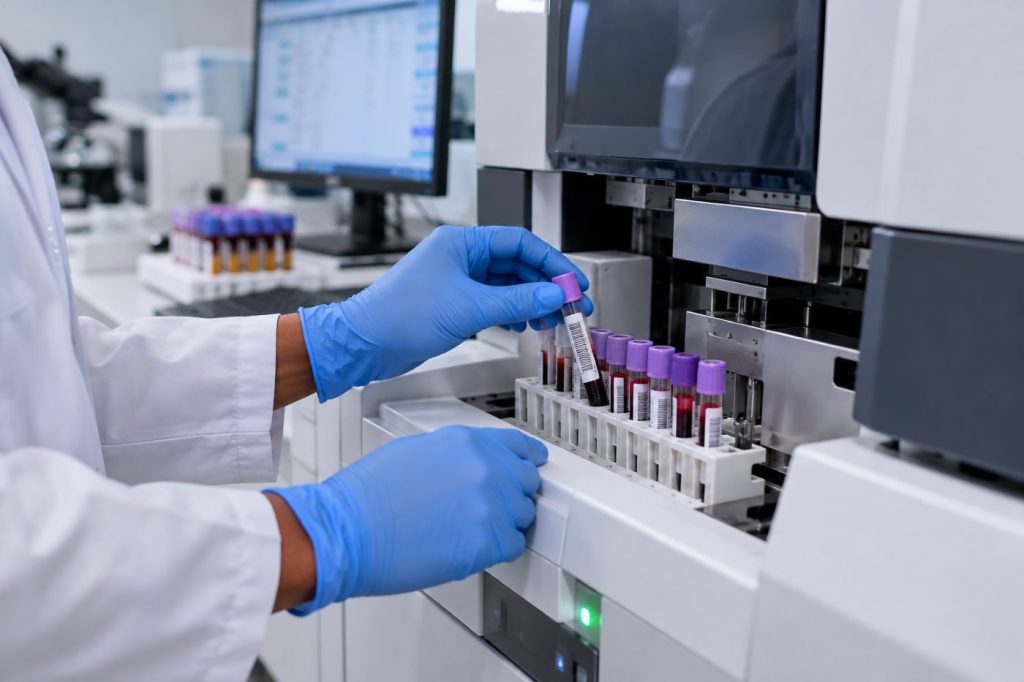
When you give a blood sample, you see only a few seconds of the process. What happens afterwards determines whether the result can be relied upon.
The sample is only the beginning
A laboratory result depends on far more than the moment of collection.
The sample must be taken correctly, into the correct container, labelled accurately, transported appropriately and processed under controlled conditions.
An error at any stage can affect the result.
Why identification matters
A sample must be linked unambiguously to one person.
This is why staff confirm patient details more than once. Identification errors are among the most serious problems a laboratory can encounter.
What automation contributes
Automated analysers process samples through a consistent, controlled sequence.
Consistency reduces the variation that manual handling can introduce, particularly where large numbers of samples are processed.
Rapid Diagnostics uses automated haematology analysers, clinical chemistry analysers and immunoassay systems.
Automation alone is not enough
An analyser is not simply switched on and trusted.
Control samples with known values are run alongside patient samples, and performance is checked against expected results.
Where controls fall outside acceptable limits, results from that run are held until the cause is resolved.
This step is invisible to patients and is the main thing standing between a plausible number and a dependable one.
Some work remains manual
Not all laboratory work is automated.
Microbiology and histology depend on skilled technique and on biological processes that take their own time to complete.
This is part of why some results take longer than others.
Why samples are sometimes rejected
A sample that is insufficient, incorrectly labelled or unsuitable for the test may be rejected rather than analysed.
This can be frustrating, but an unreliable result is worse than no result, because it may influence a clinical decision incorrectly.
Review before release
Results are reviewed before a report is issued.
Findings inconsistent with the clinical information supplied may prompt repeat analysis or additional testing.
What this means for turnaround
Turnaround reflects this sequence rather than administrative delay.
Most results at Rapid Diagnostics are available within 24 to 48 hours, with express handling for urgent cases. Specialised work takes longer because the underlying process takes longer.
Rapid Diagnostics guidance: Laboratory results should be discussed with the healthcare professional responsible for your care.
Explore our clinical laboratory services.