Your liver works quietly in the background every day. It helps process nutrients, supports metabolism, removes waste products from the blood and performs many other essential functions.
Yet liver disease can sometimes develop without obvious symptoms. A person may feel relatively well while changes are taking place within the liver. That is one reason modern imaging techniques such as elastography can be useful.
What is liver elastography?
Elastography is an imaging technique used to assess the stiffness of body tissue.
When certain liver conditions persist over time, scar tissue known as fibrosis can develop. As fibrosis increases, liver tissue may become stiffer.
Elastography provides information about that stiffness without requiring surgery.
Rapid Diagnostics lists shear wave elastography for liver health among its advanced ultrasound capabilities.
How is elastography different from a regular ultrasound?
A conventional ultrasound creates images that help healthcare professionals examine the structure and appearance of internal organs.
Elastography adds another layer of information by evaluating tissue stiffness.
In simple terms, a normal ultrasound may help show what the liver looks like, while elastography helps provide information about how stiff the liver tissue is. The two techniques may therefore complement one another.
Why can liver stiffness matter?
Some chronic liver conditions can cause inflammation and gradual scarring.
Early fibrosis may not produce obvious symptoms. As liver damage progresses, the effects can become more serious.
An elastography examination may help a clinician assess liver stiffness and decide whether additional evaluation or monitoring is appropriate. However, one imaging result should never be interpreted in isolation.
What happens during the examination?
Ultrasound elastography is non-invasive.
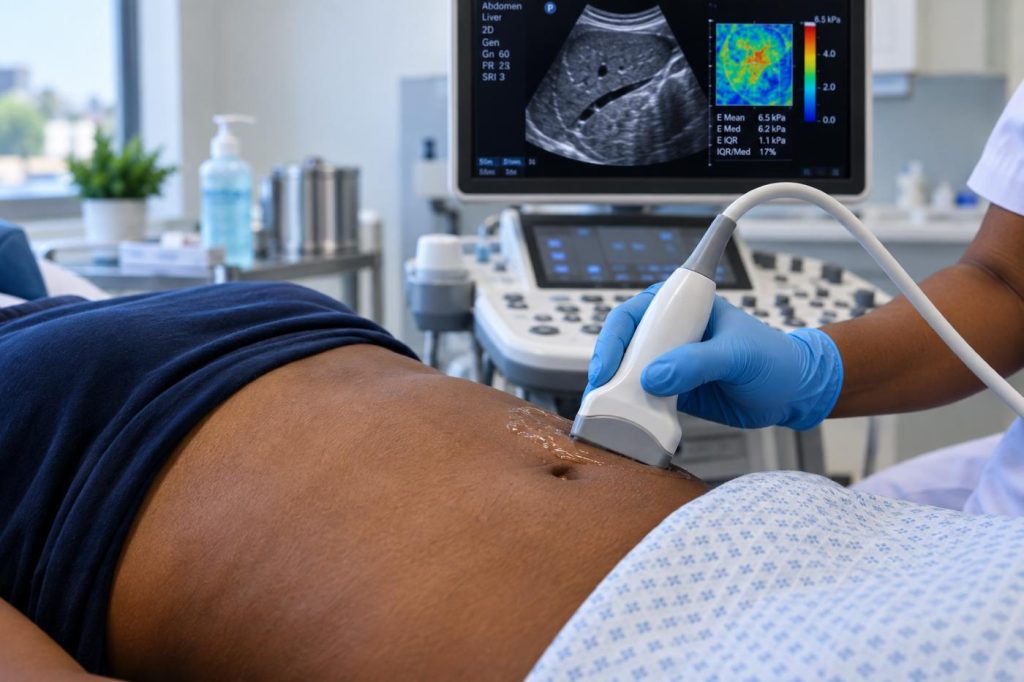
The patient lies on an examination bed while a healthcare professional places an ultrasound transducer against the appropriate area of the abdomen.
The equipment analyses how waves move through the liver and produces measurements related to tissue stiffness.
There are no surgical cuts, and ultrasound does not use ionising radiation. Preparation instructions can vary depending on the examination, so patients should follow the instructions provided when booking.
Does a high stiffness reading automatically mean cirrhosis?
No. Elastography measurements need professional interpretation.
Different factors can affect liver stiffness, and the imaging result may need to be considered alongside laboratory tests, symptoms, medical history and other investigations.
That is why diagnostic imaging should always be viewed as part of a broader clinical assessment.
When should you think about liver health?
If your doctor is concerned about your liver, abnormal laboratory results, persistent symptoms or relevant health risks, further assessment may be recommended.
Avoid attempting to diagnose yourself based on symptoms alone.
Rapid Diagnostics provides advanced ultrasound services including shear wave elastography.
Rapid Diagnostics guidance: Liver imaging results should be interpreted by an appropriate healthcare professional together with your clinical history and other investigations.
Learn more about advanced ultrasound and liver elastography at Rapid Diagnostics.